Published Works

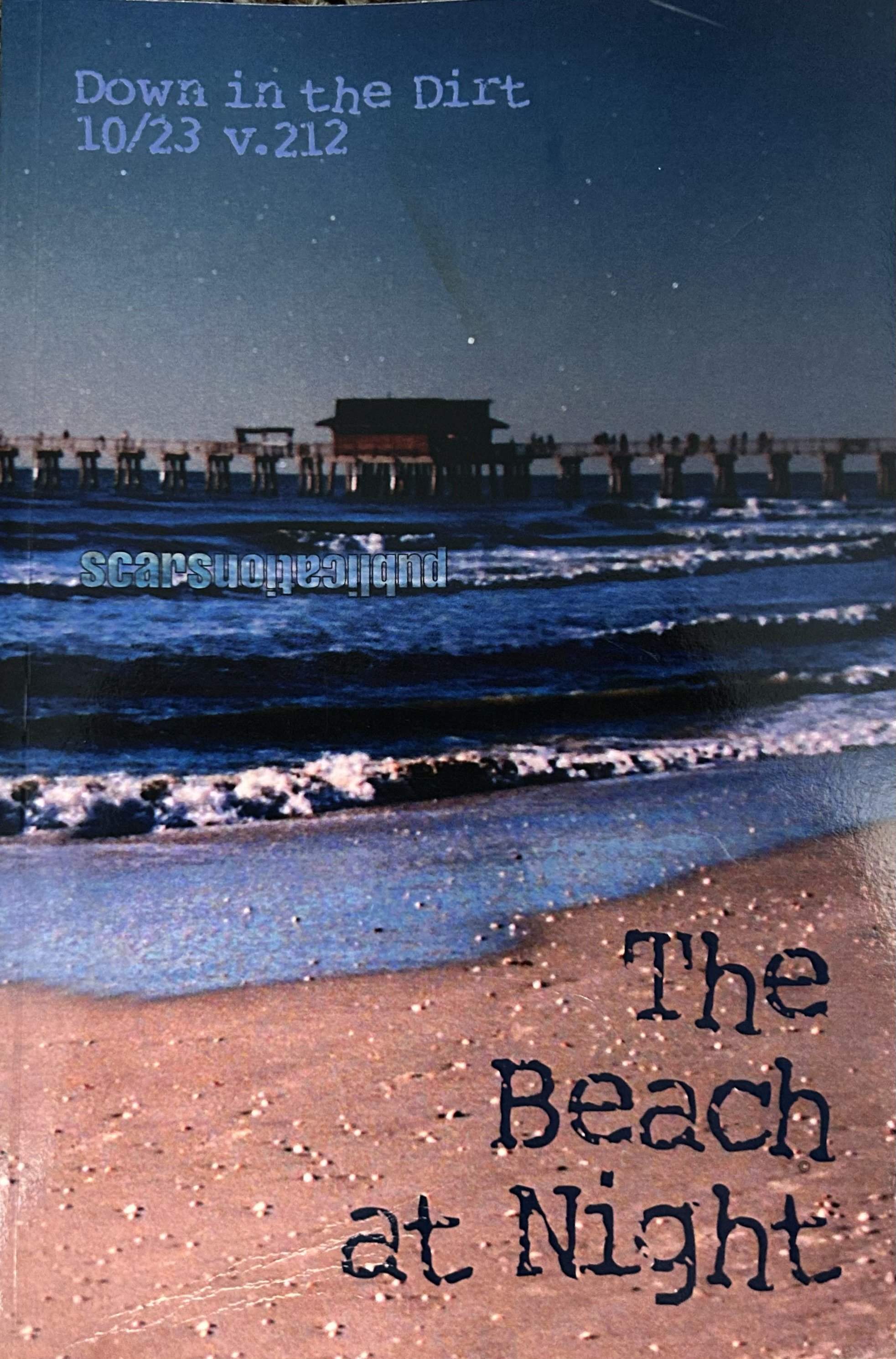
The Beach at Night: 10/23 Down in the Dirt, v212

The Beach at Night is a 2023 Scars Publications poetry and prose collection featuring work by various writers and artists. It was published as the October 2023 issue of the literary magazine Down in the Dirt.

Mary Clare's short story Early Release appears in this collection.

You can read the story below.

  • EARLY RELEASE

    by Mary Clare O’Grady

    At the sound of the screen door slamming Lily gathered her homework up from the chipped Formica table eager to escape to her bedroom. Its peeling and faded pink wallpaper was covered with glossy slick pages torn from teen magazines; images she dreamily stared into. She pushed away from the Formica, the legs of the chair squeaking against the worn linoleum floor as her mother stepped into the kitchen and threw an opened envelope on the table’s dull green surface, the return address the state penitentiary.

    “It’s from him, the bastard,” said her mother opening the cabinet with her glass and vodka bottle. “Thinks he can come back after six years and visit his daughter like nothing has happened.” She poured, splashing some of the clear liquid onto the counter. Like a seesaw one hand lowered the bottle while the other raised the half-full glass to her mouth. “And the sheriff said I can’t stop him; said he’s been granted early release. The two of them have been in this from the beginning. What a racket.”

  • Lily tried to remember her father. A vague recollection of a tall man with a soft voice. Her mother lit the cigarette dangling between her lips.

    “The sheriff himself is driving him over here.”

    “Here?”

    “He’s not to come into this house.”

    “Here?” Lily asked again watching the cigarette smoke swirl into the air over her mother’s dyed blond hair.

    “You understand? Not in this house. You can visit him outside, but don’t take long, I’ll be waiting on you for dinner.”

    The sound of tires crunched on the gravel. Lily’s head swung to the kitchen window closed to the summer heat. The floor fan blowing hot air against her legs. More liquid poured from the bottle into the glass. Her mother waved her cigarette at Lily.

  • “Go see him out in the yard.”

    On the porch, the air was as hot and sticky as her mother’s breath. Lily didn’t want to move any further into it. Sheriff Williams emerged from the driver’s seat. His boots kicked up dust as he approached.

    “Well, hello there Lily, aren’t you looking pretty tonight.”

    She looked down at her soiled T-shirt, skimpy shorts, and dirty sneakers. Her mother didn’t like her to go barefoot. She claimed Lily’s crooked toes looked like her father’s and she didn’t want anything reminding her of him. But when her mother was working at the nursing home in town Lily painted her toenails and walked through the house barefoot. She looked up into the sheriff’s sunglasses, reflecting her own image back to her.

    “You know why I’m here, Lily?”

    “My daddy’s out of prison?”

    “He is Lily and he’d very much like to see you.”

  • “He is Lily and he’d very much like to see you.”

    Her feet stuck to the porch as if the kudzu choking the hillsides were clawing up her legs.

    “It’s okay,” said the Sheriff Williams. “I’m here to keep you safe while your daddy says hello.”

    “I don’t really know him.” Lily wanted to act bold like a teenager but felt like the child when he left. “He’s been away a long time.”

    The passenger door opened; a man stretched out. Lily’s palms sweated.

    “Now, child,” said the sheriff, “take my hand and we’ll walk over to your daddy.”

    His hand was large, his fingers thick.

    “There you go Lily, you’ll be fine. He’s waited a long time to see you.”

  • Lily watched her feet move over the gravel. The sheriff dropped her hand and stopped walking. She stood stiffly beside him. A mockingbird called from the catalpa tree down by the mailbox.

    “Hi, Lily.” He crouched down, an arms-length away, eye to eye with her. “My baby doll, I’ve missed you so.” His voice lit up the space between them. “I love you ‘ya know.”

    Did he say love?

    “It was an unfortunate situation that sent me away from you, but I never stopped thinking about you.”

    Her mind filled with visions of sitting beside him on the porch swing. Evenings spent listening to his voice reciting the stories she loved: Jack and the Beanstalk, Dorothy in the Land of Oz.

    “I know it’s been a while and you’re older now, but I’d like to get reacquainted, spend time together again.”

  • The kitchen window squeaked open behind her. She pictured her mother behind its dirty curtain listening to every word. Lily looked at the collar of her father’s checked shirt anxious to hear what else he would say but it was the sheriff who spoke.

    “Your mother will be waiting on you now, Lily.”

    Her chest seized up. Her feet, uprooted from the ground, trailed the sheriff back to the house. Her father’s voice calling to her.

    “I’ll be staying at Beale’s boarding house in town. For the time being anyway, while I look for work. So, I won’t be far.”

    Lily paused at the screen door, smelled the chicken frying in the pan, and listened to her mother humming to the local country radio station out of Natchez. She moved towards the music thinking of adding a little hot sauce to her dinner like her daddy always had.

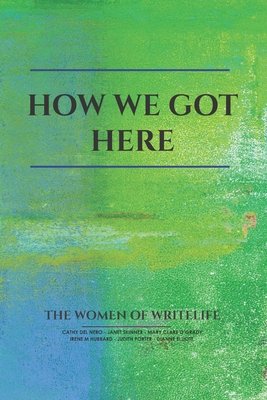
How We Got Here: The Women of Writelife

How We Got Here: The Women of WriteLife is a memoir collection from the writing workshop at Salve Regina University’s Circle of Scholars program.

Mary Clare O’Grady’s essays An English School and The Fire can be read below.

  • AN ENGLISH SCHOOL

    by Mary Clare O’Grady

    Miss Plimbletts was a very large androgynous creature. Her straight hair was cut close to her head, emphasizing her elephantine ears. The color of her hair was nondescript, as was the rest of her—devoid of color. Her British tweed suits were boxy, not really brown, not really grey; perhaps they just needed a good washing. The skirt ended below her knees, showing muscular calves falling into sturdy ankles and very large feet. Her brown oxford shoes, firmly coming down the linoleum hallway towards our classroom, could easily have fit a man.

    Without acknowledging the presence of our tiny heads bobbing around under her outstretched arm she unlocked the classroom door. The English children surged through it without a goodbye to their mothers. I clung to mine as she tried to convince me it would be okay, although her eyes indicated she wasn’t entirely comfortable leaving me in the care of this woman.

  • Without a word Miss Plimbletts offended my mother’s American sensibilities. Bending at the waist, she placed her oversized hand in the middle of my small back and, with a push, sent me towards the others and closed the door on my mother.

    Being in a classroom was a new experience for all of us and we stood not knowing what to do next.

    “Find a seat,” Miss Plimbetts said in a brusque manner.

    We scrambled into chairs.

    She moved stiffly to the front of the room like one of those wooden dolls where the only movable joints were the shoulders and hips. Turning to face us, her lips tight, she spoke as one completely in control.

    “Open your composition books.”

  • The room’s eggshell walls blended into the floor and ceiling, broken only by the blackboard in front and the windows on one side. The large panes of glass set into thick walls dated from 1610.

    Like the building, Miss Plimbetts resembled an impregnable fortress. Her age was difficult to ascertain, somewhere in that vast space between a single woman and an old maid. Perhaps if she had married and had children, she would have been kinder to us.

    She taught the first levels, ranging from age five to seven and took her job seriously. Expecting those of us in her charge to succeed at all costs, she was relentless with her teaching methods. After reciting our lessons repeatedly until memorized, she moved onto the next subject without comment or praise. She never left the front of the room, leering down at us like a court judge.

    I sat next to my neighborhood playmate, Andrew. He was used to my family’s American accent and dress, but the other children considered me an oddity. Although we were all attired in the school uniform, my white saddle shoes and brightly colored coat stood in sharp contrast to their dark oxfords and somber duffle coats.

  • The twins, Ailine and Avonne, were particularly British. Square in build, their identical pale faces were framed by stringy black hair as if a helmet had been placed on each of their heads. They enjoyed harassing the other children, something Miss Plimbetts took no notice of.

    Recess was a welcome break from her sterile and claustrophobic classroom. When the bell rang, we ran for the door, tumbled into the hallway, down the stairs, and pushed open the backdoor. The tarmac was for jump roping or ball bouncing. Beyond, the grass sloped down to the sandbox, slide, and swings where the twins unleashed their terror.

    They tied me to the swing set with jump ropes. Unable to move, I looked up the hill to our third-floor classroom window and saw the shadow of Miss Plimbetts. The bell announcing the end of recess rang. I struggled with the ropes, unable to loosen them. Panicked I’d be late and reprimanded, I yelled to my classmates swarming up the hill.

    My neighborhood friend Andrew came running and grappled with the jump ropes until I was freed. We raced up the hill, panting as we reached the building. Miss Plimbetts held the door open, gave me an apprising look and said sternly, “It’s not good to be tardy.” The door shut behind me as I scuttled up the steps away from her.

  • THE FIRE

    by Mary Clare O’Grady

    Darkness fell early that winter day on Providence College’s campus. Finals were scheduled for the following week and the studying was ferocious. The falling snow lightened the mood. Donning mittens and hats, we ran out into the quad throwing snowballs and releasing tension. Things quieted after midnight. The wet mittens and hats hung to dry, their owners fell into their beds.

    Red, yellow, and white flashing lights from the quad pulsed on the edges of my window shade. Feet pounded down the hallway. I opened my door to chaos.

    “There’s a fire in Aquinas Hall and they’re bringing some of the rescued girls to our lounge,” said an upperclassman running past.

  • I followed her into the lounge and encountered hysteria. Young women in pajamas cried, moaned, and screamed incoherently. I moved through them helpless, not knowing what to say or do. The red, yellow, and white lights flashed like strobe lights on the ceiling. The quad was a sea of firemen and police moving through waves of black smoke. I felt an urgent need to speak to my parents.

    In my room I picked the phone off the receiver and dialed, but there was nothing but static, the landlines jammed. Dark hours passed. A new day began.

    The walkway to the cafeteria was wet from the firetrucks spray. Students emerged from dorm halls and progressed slowly and quietly past the gaping dark windows of Aquinas Hall. Comments were hushed.

    “Did you see the ambulances that took some of the girls away?”

    “I heard ten of them died.”

  • “One of them jumped to her death.”

    “The fireman had yelled at her to wait.”

    Awful stories.

    Inside Raymond Cafeteria things initially appeared as they always did. The chef in his big white hat, the serving ladies with their hair up in nets. But no one checked our meal card, no one was laughing, and there were no attempts at a food fight. We filed in quietly and picked up a tray. I lifted a pastel-colored plastic plate from the pile. Still moist from the dishwasher it popped as it separated from the others. I placed it on my tray and slid it along the metal countertop separating us from the kitchen help. They silently scooped the bland food onto our plates without the usual banter, both of us ill at ease.

    Sitting down amongst friends I felt a little better. We talked of the mass Father Peterson would hold in the gym, a space big enough to accommodate all who wanted to attend. It was somewhere to go, something to do.

  • We crossed campus towards the gym, our numbers increasing. The only sound in the growing crowd was whispers. The gym filled and filled and filled. A sense of calm settled my belly. It rose up into my chest. Tears came for the first time, a feeling of relief. We hoped to be the person we were yesterday, but Father Peterson spoke of how our shared experience had changed us. He asked us to embrace it and take it with us.

    “…an opportunity to live differently for the ten of us who have been taken away.”

    I left acutely aware I had a life to live, a life that others had been denied.

    Mom picked me up from campus. I left in a bubble. Disconnecting from something that had brought so much confusion and fear, then meaning and clarity, but unable to communicate any of it. Little was said during the forty-five-minute car ride home. Surrounded by my family, I couldn’t find the words to relate what I had experienced. I wanted to share it with them, but it was too hard. So, I went upstairs to my bedroom and lay down until I was called to dinner.